
Have you ever said “hola” to someone in Spain, Mexico, or Colombia… only to see them hesitate, smile a little too politely, and then reply in English?
Or worse — you said “hello” in English, and they immediately switched back to English, as if you’d failed a test you didn’t even know you were taking.
The truth is, in Spanish, saying “hola” isn’t just saying “hello.”
It’s a social ritual. A cultural signal. A 200-millisecond decision that determines whether your conversation continues in Spanish… or whether you’re gently handed back your native language out of pity.
Cognitive linguistics shows that the average pause between speakers in a natural conversation is just 200 milliseconds. If you take longer, your brain interprets it as confusion — and most native speakers will switch to English before you even finish your sentence.
It’s not personal. It’s neurological. And your greeting? It’s the first impression your brain makes on theirs.
Here’s what no textbook tells you:
You’re not learning vocabulary. You’re learning how to belong.

Why “Hola” Isn’t Enough — The Hidden Rules of Spanish Greetings
Most learners think “hola” is the only way to say hello in Spanish. And yes — it’s correct.
But using it everywhere is like walking into your boss’s office and saying, “Hey.”
In Spanish, greetings aren’t just words. They’re signals of respect, closeness, time of day, and even your social position.
Imagine this:
You’re in a bakery in Madrid. You say, “¡Hola!” to the baker.
He smiles and says, “¡Hola! ¿Qué tal?”
Now, if you say, “¡Buenos días!” — he pauses, looks up, and says, “¡Buenos días! ¿Para llevar o para comer aquí?”
Why?
Because “buenos días” tells him you recognize the hour. You acknowledge the space. You’re playing by the rules.
And in the Hispanic world, that means:
“I see you. I respect you. I’m here with you.”
The Core Greetings — When, Where, and With Whom
Not all ways to say “hello” in Spanish are equal.
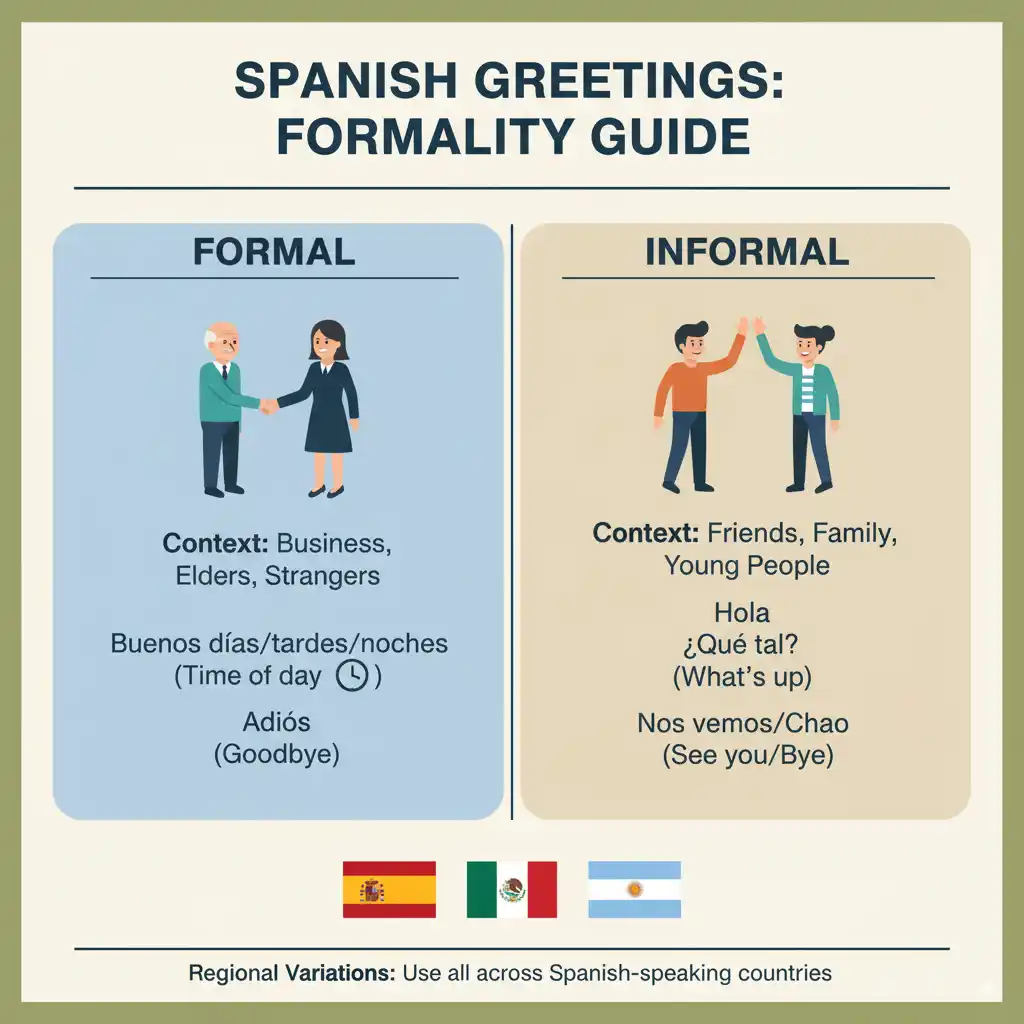
Here are the most common ones — organized by context, formality, and time of day.
| Spanish | English equivalent | Literal translation | Context | Formality |
|---|---|---|---|---|
| Hola | Hello | Hello | General use. Safe in most situations. | Neutral |
| Buenos días | Good morning | Good (plural) days | From sunrise until 12:00 p.m. Used in shops, offices, public transport. | Slightly formal |
| Buenas tardes | Good afternoon | Good (plural) afternoons | From 12:00 p.m. until sunset. Common in workplaces and casual encounters. | Slightly formal |
| Buenas noches | Good evening / Good night | Good (plural) nights | After sunset or after dinner. Can be used as a greeting in Latin America after 8 p.m. | Slightly formal |
| Muy buenas | Hi / Hey | Very good (plural) | Informal catch-all. Popular in Spain and parts of Latin America. Used any time of day. | Informal |
| ¿Qué tal? | What’s up? | How such? | Used among friends, coworkers, or peers. Often followed by “¿Cómo estás?” | Informal |
| ¿Qué pasa? | What’s going on? | What is happening? | Very casual. Used with close friends. Can sound rude if used with strangers. | Very informal |
| ¡Hola! ¿Cómo estás? | Hello! How are you? | Hello! How are you? | The most common two-part greeting in daily life. Almost always paired. | Neutral |
✅ Key tip: In Spanish, greetings like “buenos días,” “buenas tardes,” and “buenas noches” are always plural — even when you’re greeting one person.
Saying “buen día” (singular) sounds unnatural — even if it’s grammatically possible.
It’s like saying “good day” in English: correct, but stiff.
Native speakers use the plural because it feels warmer, more inclusive.
It’s not grammar — it’s kindness.
The Cultural Secret: “Muy buenas” Is the New “Hey” (Especially in Spain)
Here’s what no YouTube video tells you:
In Spain — especially in cities like Madrid, Barcelona, or Valencia — “Muy buenas” has replaced “hola” in casual settings.
- At a café: “¡Muy buenas!” → barista replies: “¡Muy buenas! ¿Qué quieres?”
- On the street with a neighbor: “¡Muy buenas, Juan!”
- In a bar: “¡Muy buenas, tío!” — even if you’ve never met before.
This isn’t slang. It’s linguistic evolution.
And if you use it?
You don’t just sound fluent.
You sound local.
But be careful: In Mexico, Colombia, or Argentina, “muy buenas” can sound forced — even funny.
There, “¿Qué tal?” or “¡Hola!” are safer bets.
The Fatal Mistake: Using “Adiós” to Say “Hi”
Many learners think “adiós” is the formal way to say hello.
It’s the opposite.
“Adiós” comes from “a Dios” — “I commit you to God.”
It’s used for permanent goodbyes.
If you say “¡Adiós!” to your coworker, your neighbor, or your friend on the street…
… they’ll assume you’re leaving forever.
🚫 Common mistake:
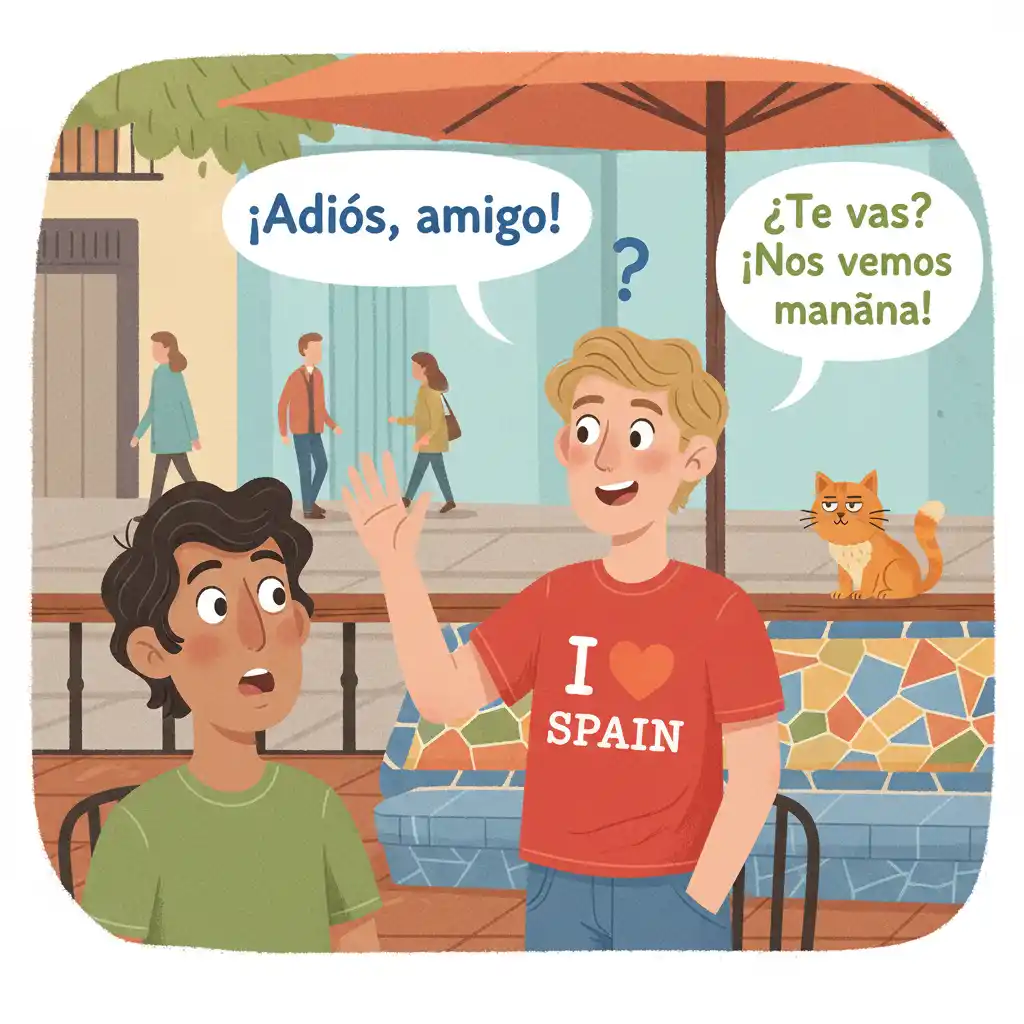
Tourist in Seville: “¡Adiós, amigo!”
Local: (confused look) “…Are you leaving?”
Tourist: “No, I just wanted to say hello!”
Local: (sighs) “Say ‘hola.’”
The correct word to greet someone?
“Hola.”
The correct word to say goodbye?
“Nos vemos.” “Hasta luego.” “Chao.”
The Forgotten Details: How to Greet in Real Life
✅ 1. On the Phone: It’s Not “Hola” — It’s “Bueno” or “Aló”
- In Mexico, Peru, Ecuador: “Bueno” → “Hello?” (as in “I’m ready, go ahead”)
- In Colombia, Venezuela: “Aló” → “Hello?” (used only on the phone)
- In Spain: “Diga” → “Tell me” (direct, efficient, very Spanish)
If you answer the phone with “hola,” you sound like a tourist.
If you say “bueno,” you sound like someone who lives here.
✅ 2. In Groups: You Must Greet Everyone — One by One
In many Latin American countries, greeting just one person in a group is considered rude.
- At a family gathering in Colombia:
“¡Hola, tía! ¡Hola, tío! ¡Hola, prima!” → each person responds. - If you say only “¡Hola!” to the group…
… someone will say: “¿Y a mí no me saludaste, hijo?”
✅ 3. “Hola” Is Neutral — But “¡Buenos días!” Is a Gift
In a store, bank, or restaurant, saying “¡Buenos días!” isn’t just polite.
It activates a warmer response.
Try this:
- “Hola, ¿me das un café?” → quick, neutral reply.
- “¡Buenos días! ¿Me puedes dar un café, por favor?” → slower, kinder, more helpful.
The greeting sets the tone.
And in Spanish culture, tone matters more than words.
The Real-World Tip: How to Sound Like a Local — Not a Textbook
You don’t need to memorize 20 greetings.
You need to remember three rules:
- Use “buenos días,” “buenas tardes,” or “buenas noches” in public places, with strangers, or in formal settings.
→ More respect = more warmth. - With friends, family, or people your age, use “hola” + “¿qué tal?” or “¿cómo estás?”.
→ “Hola, ¿qué tal?” is the everyday rhythm of Spanish conversation. - When in doubt, say “muy buenas” — and smile.
→ Works in Spain. Works in many parts of Latin America.
→ It’s the modern, flexible, safe version of “hello.”
Bonus: What to Say After “Hola”
Once you say “hola,” the conversation doesn’t stop.
The next line is critical.
If someone says “hola” to you, respond with:
→ “¡Hola! ¿Qué tal?”
→ “¡Hola! ¿Cómo estás?”
→ “¡Hola! ¿Cómo va tu día?”
Never reply with just “hola.”
That sounds robotic.
In Spanish, a greeting is an invitation to connect.